




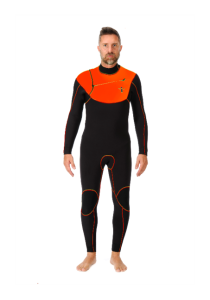
 The market now offers a wide range of models and types of wetsuits, but choosing the one best suited to your needs is not always easy—especially without being influenced solely by the price.
The choice of wetsuit (in terms of model and thickness) depends on several key factors:
-
-
Sport discipline it is intended for
-
Frequency of use throughout the year
-
Type of usage (work-related, competitive sports, leisure)
-
Spot/Location where it will mostly be used and, consequently, the water temperature
-
Level of experience in the practiced sport discipline (it is often overlooked that beginners usually stay in the water longer and therefore require greater thermal protection)
-
Which type of closure should you choose (Back Zip, Front Zip, or Zipless)?
What are the pros and cons of each option?
Currently, the market offers different zipper closure solutions. The main difference lies in how easy the wetsuit is to put on and take off. Each option has advantages and disadvantages:
Zipper: Back Zip (Rear Closure)
Advantages:
Easy to put on and take off, especially for people with physical limitations. Often preferred by women due to the chest area.
Disadvantages:
Greater water penetration (zippers used in “wet” wetsuits are not watertight) due to the longer zipper length and its rear position, which allows water entry as soon as it reaches hip level. The back zipper also introduces a degree of rigidity along the spine that can limit movement.
Zipper: Front Zip (Frontal Closure)
Advantages:
Less water penetration due to generally fewer cuts/panels in the wetsuit, and greater comfort during movement.
Disadvantages:
More difficult to put on and take off, especially for wetsuits thicker than 4 mm.
Zipper: Zipless (No Zipper)
Advantages:
Less water penetration thanks to fewer seams/panels and more freedom of movement.
Disadvantages:
Harder to put on and take off, especially for thicknesses from 4 mm and above. Greater wear on the chest and neck areas as they must be highly elastic and are subject to repeated material stress during donning and doffing.
Note: Wetsuits using plastic zippers and sliders are preferable to those with metal ones, as the latter are more prone to corrosion, especially if the wetsuit is unused for long periods.
How do you assess the quality of a wetsuit?
The quality of a wetsuit primarily depends on the technical characteristics of the neoprene used. Additionally, manufacturing methods (e.g., the fewer the “panels,” the better the wetsuit performance) and the materials used (e.g., thread, finishes such as taping, reinforcements, accessories) play a role.
Another crucial factor is its durability over time, meaning its ability to maintain its characteristics when exposed to harsh environments such as saltwater and sun radiation.
Final Considerations
A wetsuit must fit very snugly to function well thermally—so much so that the first time you put it on, it might feel too small. However, it’s important to remember that neoprene becomes more elastic and adaptable once wet.
A wetsuit that’s too loose—even if it’s easier to wear—will allow pockets of water to form inside, decreasing thermal efficiency and increasing the overall weight.
