




 Consulting the Treccani encyclopedia under the entry “neoprene” you will find the following definition:
neoprene s. m. [comp. of neo- and (chloro)prene]. – In a strict sense, it is the trade name for various types of synthetic rubber made from the polymer of chloroprene (or polychloroprene); later, the term extended in common usage to indicate similar materials from other producers, and even any material obtained from the vulcanization of a mixture of elastomers that includes polychloroprene: neoprene glue; neoprene coating, neoprene gasket.
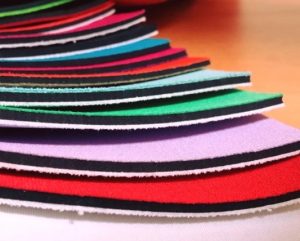
Let’s begin by clarifying that the term “neoprene” refers exclusively to the “rubbery” part of the material, that is, the layer between the two linings (in other words, the black part visible in the photos).
The invention of neoprene, technically named “polychloroprene,” came as a response to a shortage of natural rubber in the market and dates back to the 1930s, developed by two scientists from the American multinational DuPont, Wallace Carothers and Arnold Collins. Originally, the resulting “foam” was named “duprene.”
Neoprene started to be used for wetsuits around the 1950s, initially without any lining, by US Navy divers to reduce the thermal dispersion of body heat while staying in deep and cold waters for long periods. Without lining, however, these wetsuits were often prone to tearing and uncomfortable to put on and take off.
Only in the 1960s did the process of “laminating” neoprene begin by gluing different types of linings to one side (thus producing single-lined neoprene) or to both sides (resulting in double-lined neoprene). In the first case, depending on the finish of the rubber, one can obtain “open cell” or “split” neoprene (with a porous surface) or “smooth” neoprene (with a very smooth and slippery surface, such as Smooth Skin or Glide Skin neoprene).
As for the variety of linings that can be laminated/glued to the surface of neoprene, many solutions are now available (nylon, polyester, lycra, brushed materials, etc.) and in a wide range of colors.
Linings can also be categorized into three macro-groups in terms of elasticity/stretch: standard stretch (low elasticity) – “2 ways” (stretch only in two directions with medium elasticity) – “4 ways” (super stretch, working in all four directions with high elasticity).
N.B. – It should be noted that the elasticity of neoprene (whether single-lined or double-lined) depends on the category of laminated linings, i.e., it will have the elasticity of the least elastic laminated lining.
Also in the 1960s, the Japanese Yamamoto Corporation introduced a new type of neoprene different from the petroleum-based versions made until then. This innovative technology converts calcium carbonate, from limestone, into chloroprene rubber chips, which are then vulcanized. To enhance its physical and chemical properties, the resulting product can be mixed with various additives such as plasticizers, antioxidants, and pigments, depending on the desired final application. Nowadays, neoprene is made in various “foams,” each identified by a letter (S, L, K, etc.), indicating its chemical and physical properties (such as density, thermal factor, elongation, compression resistance, etc.).
Once the foam is produced, the neoprene is “cut” to size to obtain the desired thickness and can eventually be “laminated” at a later stage. The minimum common thickness is 0.5 mm.
N.B. – Please note that the neoprene thickness declared at the time of wetsuit sale refers only to the “foam” and therefore does not include the thickness of the linings.
The limestone-based neoprene produced by this process has a high micro-cellular structure which, compared to traditional oil-based neoprene, provides significant improvements in terms of:
- Waterproofing
- Thermal Factor
- Lightness
- Elasticity
- Durability
There is a difference between neoprene used for water sport wetsuits (surf, kitesurf, windsurf, etc.) and that used in diving.
This difference mainly concerns the microcellular structure of the “foam.” Neoprene used for diving wetsuits must account for water pressure and the greater dispersion of body heat with increasing depth.
Furthermore, distinctions within the diving sector must be made based on the activity: snorkeling, freediving, or scuba diving (with compressed air), using neoprene with varying softness and buoyancy or greater resistance to compression for deep diving. In the water sports sector, distinctions are also made based on the sport.
For swimming or triathlon, for example, single-lined neoprene is used to ensure greater fluidity in water, with up to three different neoprene thicknesses used in the same wetsuit model.
Conclusion
Compared to natural rubber and other synthetic rubbers, neoprene offers superior resistance to chemical and environmental agents, as well as greater thermal stability.
In summary, neoprene is a highly versatile material due to its chemical and physical properties, including:
- Elasticity and flexibility
- Thermal stability
- Resistance to chemical and atmospheric agents
- Abrasion and compression resistance
- Non-conductivity of electricity
- Resistance to permanent deformation
- Protection against impacts and vibrations
Its composition and performance characteristics make it suitable for a wide range of applications, from industrial products to consumer goods. Neoprene is currently used in a wide variety of items in major industrial sectors such as: chemicals, automotive, mechanical, marine, sportswear, transportation, construction, medical devices, and more.
Neoprene is commonly sold in “sheets,” typically sized at 120 × 220 cm with a commercial tolerance of +/-5%.
In the next article, we will explore the topic of “sustainability” in relation to neoprene, examining both new product types defined as “green or eco-friendly” and aspects related to its recycling and/or disposal.
